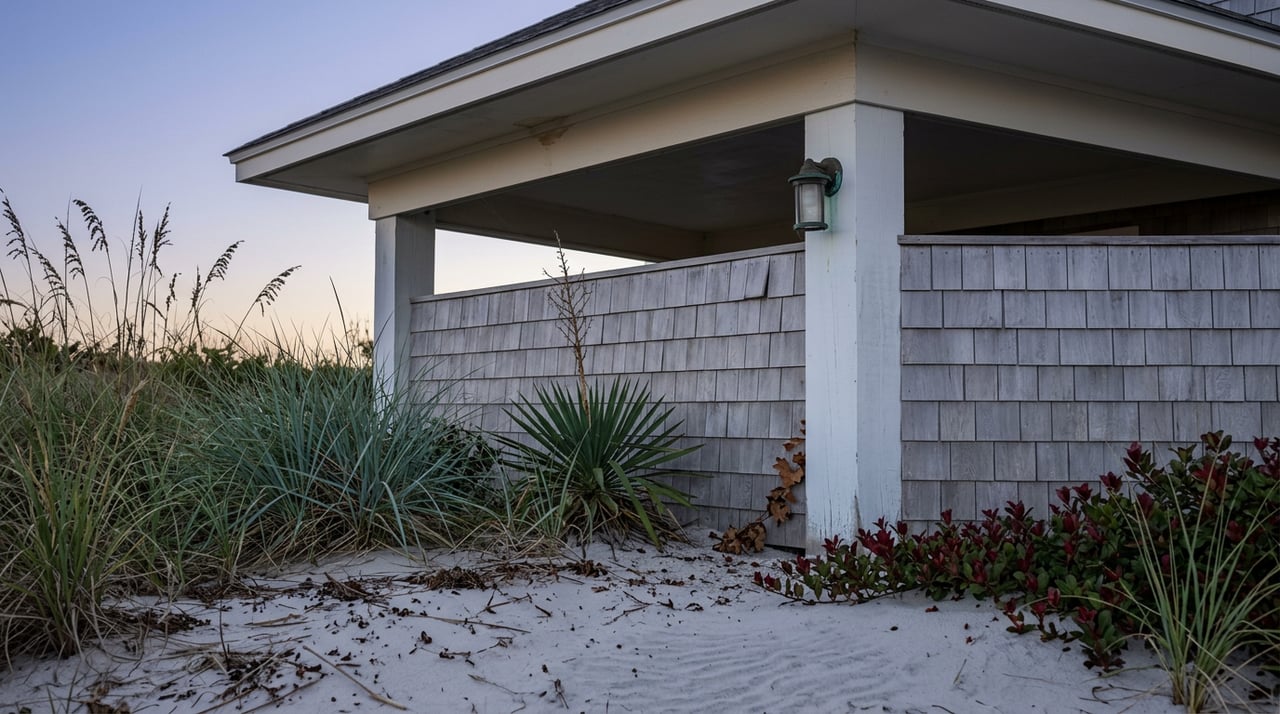
Walk the strand before 7 a.m. this week and you'll likely pass someone scanning the sand with the particular focus of a person looking for something specific. A little further on, near one of the beach accesses, a short length of rope and a hand-lettered sign mark off a patch of sand no bigger than a car hood. Walk the same stretch again after dinner, and the mood has changed entirely. Porches that blazed with string lights in June are dimmer. Someone's flashlight beam, if it's on at all, is pointed down at the ground instead of out toward the water.
Most residents file all of this under one heading: turtle season. It isn't one thing. Wrightsville Beach is currently running two separate turtle operations on the same sand, on two different clocks, and knowing which one you're looking at determines whether the right move is to watch or to look away.
Two Clocks, One Beach
Loggerhead sea turtles come ashore at night to nest, and in coastal North Carolina that happens between May and the end of summer. The Wrightsville Beach Sea Turtle Project (WBSTP), the volunteer group that has monitored this beach for decades, defines the local nesting window as May 1 through August 31. The Town of Wrightsville Beach's own guidance frames the broader state season as running through October 31, since that later date accounts for the tail end of hatching, not new nests.
That gap between the two dates is the whole story. A loggerhead nest takes roughly 45 to 70 days to incubate. A nest laid in mid May could already have hatched in early July. A nest laid this week won't hatch until sometime between mid September and mid October. Which means for the last few weeks of nesting season, the beach is doing both jobs simultaneously: welcoming new nests at dawn while quietly waiting out old ones at dusk.
A few numbers worth holding onto:
- Nesting season for new nests closes August 31. After that date, whatever is in the sand is what you get.
- Incubation runs 45 to 70 days from the date a nest is confirmed.
- WBSTP calculates an estimated hatch date from that window, but the actual night can land up to two weeks earlier or later. Nobody, including the volunteers, can tell you exactly when.
- The volunteer season itself doesn't officially end until September or October, timed to whenever the last nest of the year finally hatches.
The Dawn Half of the Job
Because loggerheads nest under cover of darkness, actually seeing one dig a chamber and lay her eggs is rare. So WBSTP volunteers walk the length of the beach every morning at sunrise, from May through the end of August, looking for tracks instead. A loggerhead's crawl leaves a mark about 40 inches wide, flat in the center where her body dragged, with flipper prints on either side, resembling something closer to ATV tire tracks than footprints. One set points up toward the dune line, a second points back to the water, and the space between them is where a trained eye starts to dig.
Once a nest is confirmed, it gets roped off and marked with a sign, and the neon-flagged stakes you might notice tell you a volunteer has already found and identified that particular set of tracks. If you spot tracks that aren't flagged yet, WBSTP wants the call: 833-4-TURTLE.
Volunteering with the project is a season long commitment that starts with a training meeting in March, and the group is explicit that participants must be permanent residents of the greater Wilmington and Wrightsville Beach region for the duration. This isn't a program built around seasonal help. Longtime volunteers Dick and Linda Chapman have been walking this same stretch of sand looking for tracks since 2000.
That commitment sometimes extends past routine patrol. In September 2025, a volunteer spotted an injured turtle in Little Lollipop Bay, just north of the US 74 bridge, and called WBSTP president Nancy Fahey, who went into the water herself to help pull the animal to shore. She later described the effort simply: the team "got to the sandy beach so we could get her out of the water." WBSTP doesn't rehabilitate turtles on site. That one was transported to the Karen Beasley Sea Turtle Rescue and Rehabilitation Center in Surf City, the region's dedicated hospital for sick and injured turtles.
The Dusk Half of the Job
Once a nest is confirmed and roped off, the job flips from finding to waiting. As a nest nears its estimated hatch window, volunteers begin what the project calls nest sitting, monitoring it more closely in the evenings since hatchlings, like their mothers, only emerge after dark, any time between dusk and dawn.
This is where the porch lights matter. Artificial light disorients hatchlings, which instinctively crawl toward the brightest horizon, normally the open sky over the ocean. A lit house behind the dune line can pull an entire nest the wrong way. WBSTP deliberately does not publish nest locations or estimated hatch dates online, precisely because the nests need to stay undisturbed and unannounced. So the honest answer to "when will it hatch" is that nobody outside a small group of trained volunteers knows, and even they're working off a two week margin of error in either direction.
That means somewhere along this beach, right now, in the first week of August, there is very likely a nest sitting inside its due date window with no public marker beyond a rope line and a sign. The practical version of respecting that: keep exterior lighting low near the dunes through the fall, and if you happen to walk past a roped off section of sand after dark, that's not the moment to bring out a flashlight for a closer look.
A Second Schedule, Running Alongside the Turtles
Turtles aren't the only species with a season on this beach. Wrightsville Beach also hosts nesting shorebirds, including Least Terns, Black Skimmers, and Wilson's Plovers, protected through a separate partnership between the town and Audubon North Carolina. Their nesting areas, concentrated around the South End Bird Sanctuary, run on their own calendar and their own volunteer program, distinct from WBSTP's turtle patrols.
If you want to see that side of the conservation work in person, Audubon's Bird Steward Program leads a free educational walk every Monday morning during summer at 9 a.m., starting at Beach Access #43. It's a different day, a different hour, and a different set of species than the turtle program, running on the exact same stretch of sand.
If You Want to See Any of This
None of this requires a permit or a special invitation. It just requires knowing where to show up.
- Every Tuesday evening this month, WBSTP hosts a free, family friendly Turtle Talk at 7 p.m. at the N.C. Coastal Federation building on West Salisbury Street.
- Every Monday morning through summer, Audubon North Carolina leads a free bird walk at 9 a.m. from Beach Access #43.
- If you spot unmarked tracks or an injured turtle, the local hotline is 833-4-TURTLE.
- Dogs are not permitted on the beach strand between 9 a.m. and 6 p.m. from Memorial Day through Labor Day, a rule that holds regardless of what's happening with the nests.
By the time you've walked this beach a few times with this in mind, the pattern is easy to read. A fresh stake near the dune line at sunrise means someone came ashore last night. A quiet rope line at dusk, with no new flags and no fanfare, means something already here is getting close. One is a beginning. The other is nearly an ending. Both are happening on the same sand this week, and most people walking past only ever notice the one they happen to be looking for.
If a place that pays this much attention to its own quiet seasonal rhythms is the kind of coastal life you're drawn to, Lynne Galloway has spent more than two decades living and working right along this stretch of sand. Let's Connect.